
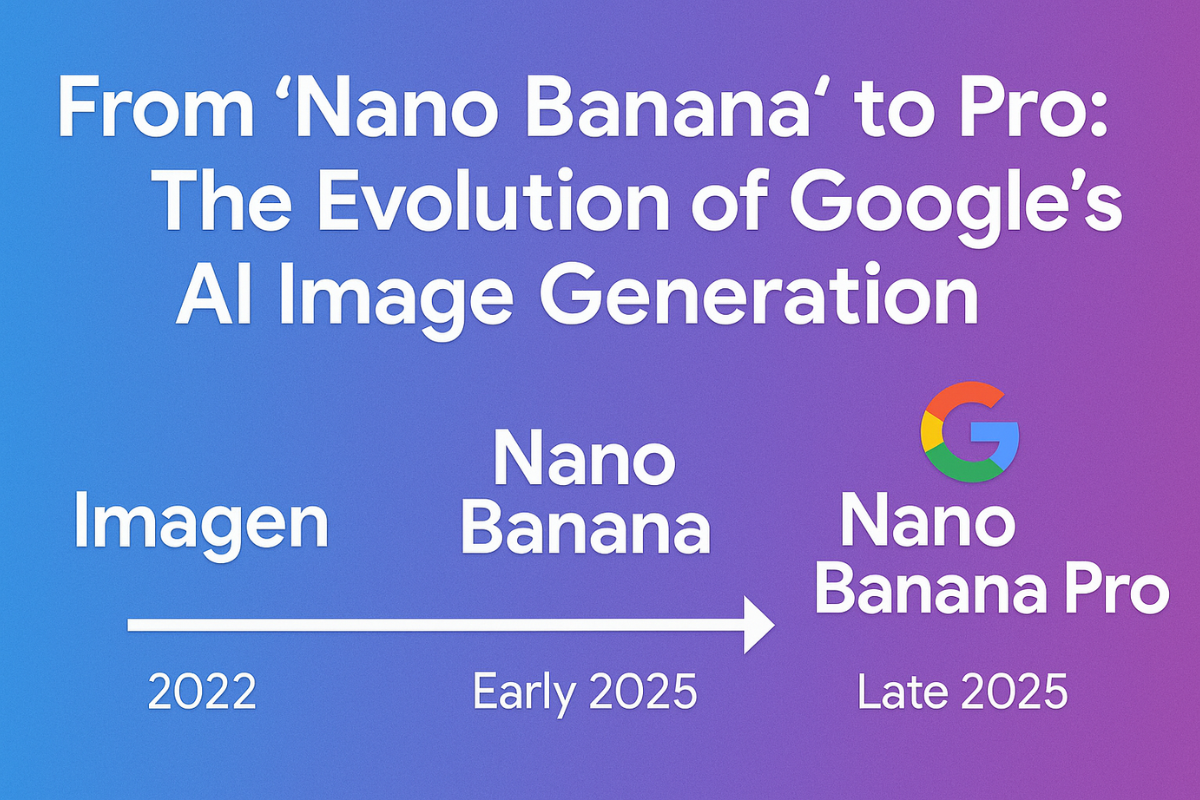
From “Nano Banana” to Pro: The Evolution of Google’s AI Image Generation
AI image generation has advanced at an extraordinary pace in just a few years. What began as experimental research demos has rapidly evolved into production-ready tools used in everyday products. Google’s journey in this space reflects both technical ambition and a cautious, measured approach—moving from groundbreaking research to playful experimentation, and finally to enterprise-grade deployment with Nano Banana Pro.
So how did Google get from early AI image experiments to a sophisticated, Gemini-powered image generator now embedded across its ecosystem?
Early Foundations: Imagen and Parti (2022)
Google’s role in modern AI image generation became clear in 2022 with the unveiling of Imagen, a text-to-image model developed by Google Research. Imagen impressed researchers by outperforming models like DALL·E 2 in several benchmarks, particularly in photorealism and language understanding. Its ability to translate nuanced text prompts into highly realistic images demonstrated Google’s deep technical capabilities.
However, Imagen was never released publicly. Google cited concerns around bias, misuse, and responsible deployment—signalling a pattern that would define its approach: innovate early, release later, and only when safeguards are in place.
Around the same time, Google introduced Parti, a model that generated images token by token, highlighting alternative approaches to visual generation. Together, Imagen and Parti laid the groundwork for future systems, contributing techniques that would later be folded into Google’s broader AI ambitions.
The Road to Gemini: A Multi-Modal Vision
Rather than launching a standalone image generator for the public, Google pursued a larger goal: a single, multi-modal AI system capable of understanding text, images, and more within one unified model. This vision became Gemini, following the merger of Google Research and DeepMind.
By 2023 and 2024, hints of Gemini’s development began to surface, alongside internal code names that sparked curiosity—one of which was the now-infamous “Nano Banana.” What started as an internal label quickly became a talking point in AI circles, blending cutting-edge research with an unexpectedly playful identity.
Google’s decision to wait until image generation could be integrated into Gemini reflected its belief that visuals should not exist in isolation, but as part of a broader reasoning-capable AI.
Nano Banana (Gemini 2.5 Flash Image): Early 2025
Google’s first public step into consumer AI image generation arrived in early-to-mid 2025 with Nano Banana, built on Gemini 2.5 Flash Image. The “Flash” designation signaled its focus: speed and accessibility.
What Nano Banana Introduced
-
Fast image generation for casual creativity and experimentation
-
Basic photo editing and restoration
-
Early support for character consistency and simple image blending
-
Easy access through the Gemini app and testing environments
Nano Banana quickly gained popularity, aided by its approachable name and low barrier to entry. Google Cloud later noted that it became one of its top-rated image models at launch, suggesting strong user engagement even if it didn’t dominate social media headlines like Midjourney.
Limitations
Despite its strengths, Nano Banana had clear constraints:
-
Text within images was often unreliable
-
Resolution was relatively modest (around 1K)
-
Complex, multi-step prompts were hit-or-miss
Still, it served its purpose: introducing millions of users to AI image generation in a safe, playful way.
The Leap to Nano Banana Pro (Gemini 3): Late 2025
On November 20, 2025, Google DeepMind announced Nano Banana Pro, powered by the newly released Gemini 3 Pro Image model. This marked a turning point—from experimentation to serious, production-grade image generation.
Major Advancements
-
Advanced reasoning and context awareness, enabling accurate text and factual visuals
-
High-resolution output up to 4K, suitable for professional and print use
-
Multi-image input expanded to 14 references, enabling complex composition and style consistency
-
Precise editing controls using natural language
Nano Banana Pro transformed image generation from a novelty into a tool capable of producing infographics, marketing assets, and detailed visual explanations in a single pass—without the glitches common in earlier models.
Broader Rollout
Unlike the original Nano Banana, which lived primarily in the Gemini app, Nano Banana Pro launched simultaneously across:
-
Google Cloud (Vertex AI)
-
Google Ads
-
Google Workspace (Slides, Vids)
This wide deployment reflected Google’s confidence in the model’s maturity and safety.
Despite the technical leap, Google retained the playful branding—a decision that Ars Technica and others noted as a rare mix of seriousness and humor in enterprise AI.
Nano Banana Pro in the Context of Gemini’s Evolution
Nano Banana Pro is best understood as one facet of Gemini, not a standalone product. Around the same time, Gemini 3 also introduced major improvements in language reasoning and agent-like behavior, positioning it as a direct competitor to top-tier general AI models.
What makes this evolution notable is convergence:
-
The same AI can chat, generate images, edit visuals, and reason across modalities
-
Users can reference images within conversations and modify them dynamically
-
Image generation benefits directly from Gemini’s broader intelligence
This shift—from single-purpose models to multi-talented systems—defines the current phase of AI development.
Measuring Progress Over Time
The evolution becomes clear when comparing capabilities across generations:
-
Text in images: From near-total failure in early models to full sentence accuracy in Nano Banana Pro
-
Character consistency: From unstable appearances to reliable identity across multiple scenes
-
Complex prompts: From simple descriptions to multi-step compositional reasoning
These gains reflect advances in model architecture, training scale, and alignment techniques.
User Adoption and Impact
Nano Banana introduced everyday users to AI image creation in a friendly, accessible way. Nano Banana Pro, by contrast, targets serious workflows—design, education, advertising, and enterprise content creation.
AI image generation has moved from a niche hobby to a mainstream productivity tool, embedded directly into software people already use. That shift represents a profound change in how visual content is created.
Looking ahead, Google’s documentation already hints at what’s next: video generation (via Gemini’s Veo model), and possibly even 3D. Nano Banana Pro is not the end of the story—just the latest milestone.
Conclusion
Google’s journey from Imagen to Nano Banana to Nano Banana Pro illustrates a deliberate path: innovate early, deploy carefully, and scale widely once quality and safety align. What began as research demos has matured into a robust, multi-modal system integrated across Google’s ecosystem.
As Gemini continues to evolve, it’s likely we’ll see even more advanced “Pro” iterations—and perhaps entirely new creative mediums—built on the same foundation. From playful beginnings to professional-grade output, Nano Banana’s evolution mirrors the broader maturation of AI itself.